The short version
Owner-operators find freight in four ways: a load board, repeat brokers who have covered their lanes before, direct shipper freight that never reaches a board, and a dispatch service paid to search and negotiate for them. Most use more than one, and almost everybody starts on a board, because it is the only channel that works on day one with no relationship behind it. A board costs a fixed monthly price and your own time; a dispatcher costs a share of every load and keeps the broker relationship in their name rather than yours.
Every carrier asks this in the first month and most of them ask it again two years later, because the answer changes once you have a few brokers who know your name. What does not change is the list of places freight comes from. There are four, and the decision is which mix of them you run.
How do owner-operators find loads?
Four channels, and most owner-operators use more than one. A load board shows spot freight posted by brokers and shippers. Repeat brokers call you directly once you have covered their lanes well. Direct shipper freight is contracted and mostly never reaches a board. A dispatch service searches, calls and negotiates on your behalf for a share of the load or a weekly fee. A board is where almost everybody starts, because it is the only one of the four that works on day one with no relationship behind it.
- A load board. Spot freight, searchable by equipment and lane, available immediately. A subscription or a free plan, and your own time to work it.
- Brokers who already know you. The cheapest freight to find, and the slowest to build. It comes from covering loads well and answering the phone, and it compounds.
- Direct shippers. Usually contracted lanes rather than spot, and rarely posted anywhere. Worth pursuing once you can prove a service record, not before.
- A dispatch service. Somebody else doing the searching and the negotiating, paid out of each load. Convenience, bought by the load rather than by the month.
How do I find loads for my truck?
Start from the truck, not the board. Your equipment type and the states you are willing to run decide which freight is even eligible for you, and both are a filter on every board. Search the lane you are sitting on now, set an alert for the lane you want next, and call before you plan a day around a posting: a covered load can stay on a board for hours after it is gone.
- Set your equipment once, accurately. A box truck searching dry van freight sees loads it cannot legally take.
- Search outbound from where you are, not from where you live.
- Save the search as an alert so the next matching load finds you instead. How load boards work covers what the fields on a posting mean.
- Call the posting before you commit a day to it, and confirm the rate against the listing.
- Check who posted it. How to spot a double-brokered load is the five-minute version of that check.
Can a carrier find freight without a dispatcher?
Yes, and most do. Nothing in federal regulation requires a carrier to use a dispatch service, and nothing on a load board is reserved for one. What a dispatcher sells is time and practice: searching, calling, negotiating and chasing the paperwork. A carrier willing to spend an hour a day on the board can do all four, and keeps the broker relationship in their own name while doing it.
The honest case for a dispatcher is the hour. Searching and negotiating happen during the day, which is when you are driving, and a carrier who tries to do both ends up doing one of them badly. The honest case against is that the relationship and the rate knowledge both accrue to whoever makes the call, and that is the part you cannot buy back later.
Load board or dispatch service: which is better?
They are less alternatives than two prices for the same job. A board is a fixed monthly cost plus your time; a dispatch service is a share of every load, or a flat weekly fee, plus somebody else’s. A board costs the same whether you run one load a week or ten, so it gets cheaper per load as you grow, while a percentage does the opposite. The lasting difference is whose name is on the relationship: loads you booked yourself are yours to repeat.
| Load board | Dispatch service | |
|---|---|---|
| What you pay | A fixed subscription, or nothing on a free plan | A share of each load, or a flat weekly fee |
| What it costs as you grow | The same, so less per load | More, because it is priced per load |
| Who negotiates | You | Them, inside limits you set |
| Who the broker knows | You | Them, usually, until you take it over |
| What you learn | What your lanes pay, first-hand |
Does a dispatch service need broker authority?
It depends on how it operates. FMCSA guidance treats a dispatcher who represents a single motor carrier, under that carrier’s direction, as its agent, which needs no authority of its own. A service that arranges freight for several carriers and allocates loads among them is brokering, and brokering requires broker operating authority and the bond that comes with it. FMCSA has said it decides these on the facts of each arrangement rather than by the label on the business.
This matters to a carrier for one practical reason: if the service is brokering without authority, there is no bond behind the money it is holding. What a freight broker bond is explains what that security is and what it is not, and the same lookup that checks a broker checks a dispatcher calling itself one.
How do new authorities get their first loads?
With paperwork ready and some patience. A new MC number has no safety history and no payment history, and some brokers will not set up a carrier under ninety days old, while others will as soon as the insurance certificate is right. The quickest route is a board where you can see the rate and the poster before you call, with a carrier packet already assembled so nothing waits on you once somebody says yes.
- Certificate of insurance with the broker named, at the limits their agreement asks for.
- A signed W-9 and your authority letter.
- A notice of assignment, if you are factoring.
- Everything else brokers routinely ask for, listed in what belongs in a carrier packet.
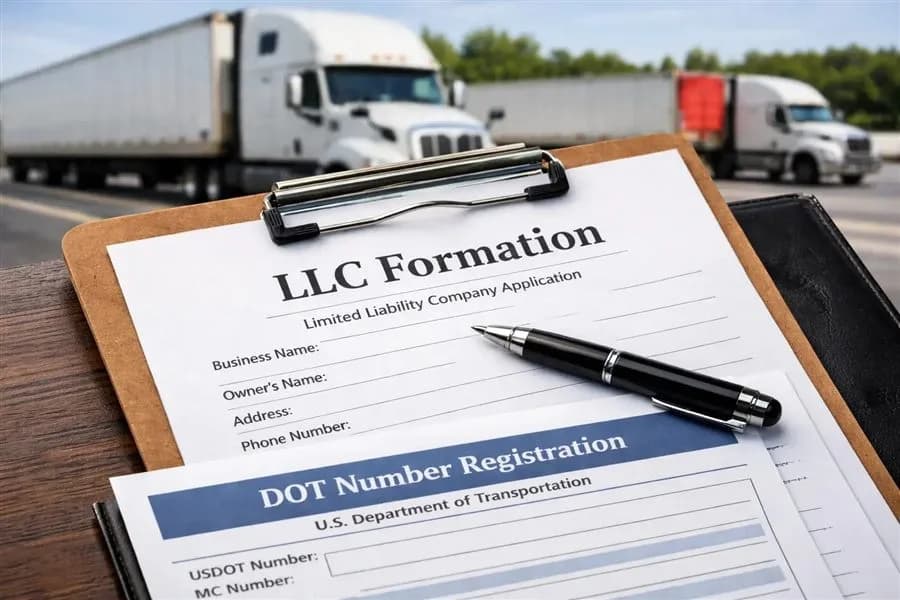
- If the authority itself is still in progress, getting your own authority is the order the steps actually go in.
The money gap is the other half of the first ninety days: you are paying for fuel now and getting paid in thirty. Is freight factoring worth it and quick pay against net 30 are the two ways carriers close it, and both cost something.
How do you keep the truck loaded after the first load?
By booking the next load before the current one delivers, and by knowing what the lane back is worth before you take the lane out. A good outbound rate on a lane with nothing coming home is often worse than a lower one on a round trip, and that arithmetic is the whole job once the truck is moving.
Finding a backhaul covers planning the return leg, and freight rates per mile covers what a number on a posting is actually worth once deadhead and fuel are in it.
The bottom lineStart on a board because it works without a relationship, and spend the first year building the ones that mean you need it less. A dispatcher buys back the hour you do not have; what it cannot sell you is the broker who asks for you by name.
Frequently asked questions
How do owner-operators find loads?
Through load boards, through brokers who have used them before and call directly, through direct shipper contracts, and through dispatch services paid to search and negotiate for them. Most owner-operators run a mix, and nearly all start on a board because it is the only channel that works before anybody knows you.
Can I find loads without a dispatcher?
Yes. No regulation requires a carrier to use a dispatch service, and load boards are open to carriers directly. A dispatcher is buying you time rather than access, so the question is whether an hour a day of searching and negotiating is worth more to you than the fee.
Is a load board or a dispatch service cheaper?
A board is a fixed monthly price and a dispatch service is usually a share of each load, so the board gets cheaper per load as you haul more and the dispatcher gets more expensive. The other difference is durable: loads you book yourself build broker relationships in your name.
Sources
Every figure in this article is linked in place. The full list, for anyone who wants to check the working.
- FMCSA, final guidance on the definitions of “broker” and “bona fide agents”. The agency’s own summary of when a dispatch service is an agent and when it is brokering.
- Federal Register, Definitions of Broker and Bona Fide Agents. The interim guidance and the comments behind it, including the single-carrier and allocation-of-traffic tests.