The short version
Flatbed posts the highest spot rate of the three, reefer sits in the middle, and dry van pays the least. But rate per mile is only half the arithmetic. The average truck cost $2.336 per mile to run in 2025, and flatbed carriers still finished the year at a negative operating margin. The right trailer is the one that nets the most after your costs, not the one with the biggest number.
If you are comparing flatbed, dry van and reefer, you have probably already seen the ranking. Flatbed pays the most. Dry van pays the least. Reefer sits in between. That part is true, and it is easy to check.
The problem is what happens next. A carrier reads the ranking, buys the trailer with the biggest number attached, and finds out twelve months later that the money never followed the rate.
Here is the part most comparisons skip. In 2025 the average truck cost $2.336 per mile to run, the highest figure the American Transportation Research Institute has ever recorded. That same year, flatbed carriers as a segment finished with a negative operating margin. The highest rate per mile in the market produced the thinnest result on the bottom line.
So the useful question is not which truck type pays the most. It is which one nets the most for the way you actually run: your cash position, your body, your home time, and your lanes.
Which truck type pays the most per mile?
Flatbed pays the most. In July 2026, DAT put spot linehaul rates at $2.90 per mile for flatbed, $2.75 for reefer, and $2.39 for dry van. Add the fuel surcharge and those become $3.64, $3.42, and $3.01. That order has held steady all year.
| Truck type | Spot linehaul, excludes fuel | Spot rate with fuel | Year over year, linehaul |
|---|---|---|---|
| Flatbed | $2.90 | $3.64 | +86 cents |
| Reefer | $2.75 | $3.42 | +79 cents |
| Dry van | $2.39 | $3.01 | +76 cents |
Source: DAT, July 2026 rate report. Linehaul rates exclude the fuel surcharge.
All three are up sharply from a year ago, and flatbed gained the most. But look at the month, not just the year. Flatbed was the only one of the three that fell from June to July, down 4 cents, while reefer climbed 5 cents and dry van added 2.
The ranking is stable. The gap between the rows is not. Treat any single month as a snapshot, never a forecast.
Why the highest rate per mile is not the highest profit
Because rate is revenue, not margin. ATRI put the average cost of running a truck at $2.336 per mile in 2025, up 3.4% and a record. Strip fuel out and it is $1.854. Your profit is whatever the rate clears above that line, across every mile you run, not just the loaded ones.
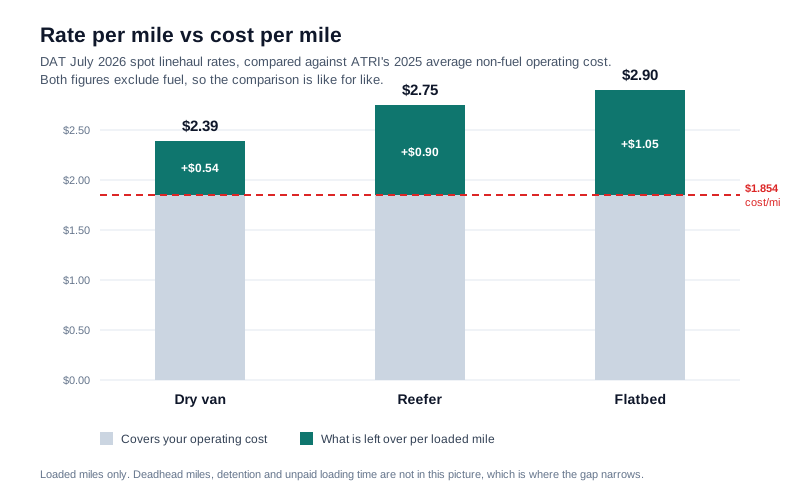
On loaded miles at spot, the cushion looks comfortable. Flatbed clears the non-fuel cost line by about $1.05 a mile, reefer by 90 cents, dry van by 54 cents.
Then reality gets a vote.
Three things eat that cushion, and none of them show up in a rate table.
- Deadhead. The rate pays for loaded miles. Your costs run on all of them. A 15% empty ratio quietly takes 15% off the top of every number above.
- Unpaid time. Tarping, chaining, waiting at a shipper and pre-cooling a reefer are hours you work without a mile turning over.
- Driver pay is inside that cost figure. ATRI’s $2.336 includes 81.8 cents a mile in wages and 21 cents in benefits. If you are an owner-operator that is your own income, not an expense to a third party, so your break-even sits lower than the industry average, and so does the money you take home from it.
If you want the real number for your operation instead of an industry average, run your own cost per mile before you compare anything else on this page.
Flatbed: highest rate, hardest work, most gear
Flatbed earns its premium. It also spends a good portion of it back before the wheels turn.
- Securement is regulated, not a matter of judgement. Under 49 CFR 393, Subpart I you need one tiedown for cargo up to 5 feet, two for cargo between 5 and 10 feet, and for anything longer, two for the first 10 feet plus one more for every additional 10 feet. The combined working load limit of your tiedowns has to be at least half the weight of the cargo.
- Tarping is unpaid time. A heavy tarp job can take the better part of an hour on each end, in whatever weather you happen to have.
- The gear is a recurring line item. Straps, chains, binders, edge protectors and tarps wear out and get replaced. That cost never shows up in the posted rate.
- Weather runs your schedule. Wind and ice change what you can safely tarp and secure, not just how comfortable the day is.
- Winter is slower. Flatbed leans on construction, steel and building materials, so the freight softens when those slow down.
If flatbed is where you are headed, look at what flatbed loads are actually posting on your lanes before you commit to the trailer.
Dry van: lowest rate, easiest entry, steadiest volume
Dry van pays the least per mile and asks the least of you in return. No tarps, no reefer unit, no temperature records.
Its real advantage is the size of the freight pool. There are roughly 1.7 million dry vans and 400,000 reefers on US roads. More trailers means more competition on any single load, but it also means far more loads to choose from, in more places.
That matters more than most rate comparisons admit. Deep freight makes a dry van backhaul easier to find, which cuts deadhead, which protects the margin that the low rate leaves you.
The catch is how thin that margin is. At $2.39 spot linehaul against $1.854 in non-fuel cost, dry van clears roughly 54 cents a loaded mile. There is not much room in that for a bad week.
Reefer: middle rate, highest running cost
Reefer sits between the other two on rate and above both on running cost. The unit itself burns diesel: newer, well-maintained units use roughly 0.4 to 1.1 gallons an hour depending on setpoint, ambient temperature, and whether you run continuous or cycle mode. On a multi-day frozen run in summer heat, that adds up to a real number.
There is paperwork attached too. Under the FDA’s Sanitary Transportation of Human and Animal Food rule, carriers hauling food have to pre-cool the trailer before loading, hold and monitor temperature in transit, keep those records for 12 months, and produce them for the FDA within 24 hours of a request.
What you get for the cost is consistency. People eat in February. Reefer freight does not swing with the construction season the way flatbed does, and produce season can push rates well above the average on the right lanes.
The three at a glance
Flatbed leads on rate and leads on effort. Reefer trades a middle rate for the steadiest demand. Dry van gives up rate to get the deepest freight pool and the lowest cost of entry.
| Flatbed | Reefer | Dry van | |
|---|---|---|---|
| Spot linehaul, July 2026 | $2.90 | $2.75 | $2.39 |
| Clears non-fuel cost by | ~$1.05 | ~$0.90 | ~$0.54 |
| Extra running cost | Securement gear, tarp replacement | Reefer fuel and unit maintenance | Lowest of the three |
| Physical work | Highest: tarping, chaining, climbing | Moderate | Lowest |
| Regulatory load | 49 CFR 393 securement | FSMA temperature records | Standard |
| Seasonality | Softens in winter | Steady year round | Follows retail cycles |
| Freight pool | Narrowest | Middle | Deepest |
Which one should you actually run?
Pick on your constraints, not the rate table. The highest-paying truck type is the wrong answer if it drains your reserves in month three, wrecks your back by year two, or sits idle every January.
- Start with your cash. Thin reserves point to dry van. It carries neither a refrigeration unit nor a securement kit, so it asks less of you up front, and the deep freight pool keeps you loaded while you build a cushion.
- Be honest about your body. Flatbed is physical work on both ends of every load. That is fine at 30 and a different conversation at 55.
- Look at your region. Construction corridors and steel country carry flatbed. Produce lanes and distribution hubs carry reefer. Retail corridors carry dry van.
- Decide how you will handle a slow winter. Flatbed’s seasonal dip is survivable with a plan and painful without one.
- Check what is posting on your lanes. Not nationally. On the roads you already run.
How to test a truck type before you buy the trailer
Look at real posted rates on your own lanes first. A trailer is a multi-year decision made on a number you can check in an afternoon.
Run the same origin and destination for flatbed, reefer and dry van. Note what is actually posting, how often, and at what rate. Then compare it against the cost per mile you calculated earlier.
Before you decide
Three things to carry out of this.
- Flatbed pays the most per mile and posted the thinnest segment margin in 2025. A high rate and a healthy business are not the same measurement.
- Your cost per mile decides which rate is good, and it is specific to your truck, your lanes and your utilisation. The industry average is a starting point, not your number.
- The freight on your lanes matters more than the national ranking. Check it before you buy anything.
The bottom linePick the truck type whose rate clears your cost on the lanes you actually run, not the one with the highest number in a national average.
Frequently asked questions
Which truck type pays the most per mile?
Flatbed. In July 2026, DAT reported spot linehaul rates of $2.90 per mile for flatbed, $2.75 for reefer, and $2.39 for dry van. Including the fuel surcharge, those figures were $3.64, $3.42, and $3.01. Flatbed has held the top spot through the year, though it was the only one of the three to slip month over month in July.
Is flatbed worth it for a new owner-operator?
It depends on your cash and your physical capacity more than on the rate. Flatbed pays the highest rate per mile, but it carries recurring securement and tarp costs, significant unpaid loading time, and a seasonal dip in winter. Flatbed carriers as a segment ran a negative 0.5% operating margin in 2025 despite leading on rate.
How much more does a reefer cost to run than a dry van?
The main difference is the refrigeration unit, which burns roughly 0.4 to 1.1 gallons of diesel per hour on newer, well-maintained units, plus its own maintenance. There is also a compliance cost: the FDA Sanitary Transportation rule requires pre-cooling, temperature monitoring, and record retention for 12 months on food loads.
Can you switch truck types later?
Yes, and plenty of carriers do, either seasonally or permanently. Some run flatbed through construction season and dry van in winter. The practical limits are the cost of the trailer and how quickly you can build a track record with brokers in the new segment.
What is the best load board for comparing rates across truck types?
Look for one that covers every truck type on a single account and shows the rate before you call. One Load Board gives full board access across flatbed, reefer, dry van, hotshot, box truck, cargo van and more on the free plan, with rate and distance visible on the listing, so you can compare all three side by side on your own lanes.
Sources
Every figure in this article is linked in place. The full list, for anyone who wants to check the working.
- DAT, July 2026 rate report. Spot and contract rates by truck type.
- ATRI, An Analysis of the Operational Costs of Trucking, 2026 update. Cost per mile, and the split between fuel, wages and benefits.
- Heavy Duty Trucking. Sector operating margins and driver pay per mile.
- eCFR, 49 CFR Part 393 Subpart I. Cargo securement rules and working load limits.
- FDA, FSMA Sanitary Transportation rule. Carrier obligations on food loads.
- Hale Trailer. Reefer unit fuel consumption range.
- Truckstop. Dry van and reefer trailer counts in the US.